Our Barbed Wire Art Logo, We have been selling our Art Sculptures since 2004
 
Click here to go to our home page Click here to go to our Barbed Wire Art Store Click here to go to our paintings store Click here to go to our about us page Click here to go to our contact us page


Home


Barbed Wire Art Sculptures

Each one of our barbed wire art sculptures are individually hand crafted. Our barbed wire art
gives your home a warm country feel. We create a variety of country farm
and ranch sculptures. Including cowboys & cowgirls,
saddles, hats, galloping and bucking horses and other southwestern decor designs.

Barbed Wire Art Barbed Point


We use vintage rustic barbed wire.
You can hang them inside or outside.


Barbed Wire Art Barbed Point Our sculptures are individually hand crafted, each one is unique, no two at BarbedWireArt.com are exactly alike. Barbed Wire Art Barbed Point


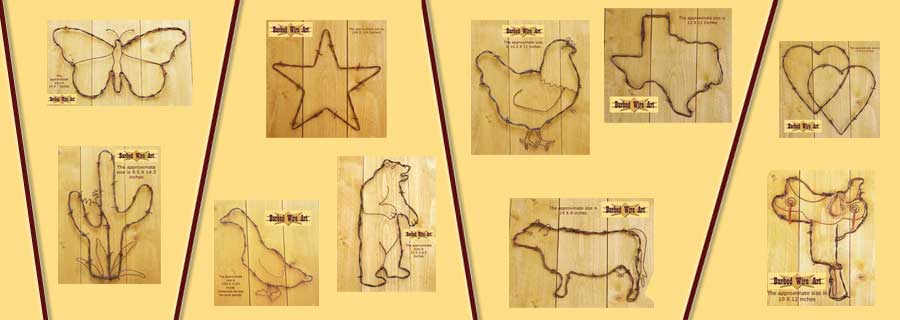
Here are just a few examples of our work, we make over 40 different sculpture designs.

 Just a few examples of our hand crafted barbed wire art sculptures.


Since each sculpture is hand made,
each one has small differences that the pictures may not show.


Want to see how our sculptures are used?  Click Here to view pictures from our customers, of how they have used our barbed wire art sculptures.


A Brief History of Barbed Wire

by Delbert Trew -1998

BEFORE BARBED WIRE

Since the beginning of time, man has constructed
his barriers from natural materials adjacent
to the barrier site. These materials were mostly wood from
trees, stone, thorny brush, and mud.

When settlers arrived on the Great Plains of America,
they found these materials in short supply,
thus creating a demand for a more economical type of fencing.

SMOOTH WIRE DEVELOPMENT

Dating back to 400 A.D., the process of pulling hot, bloom iron
through dies in a drawing plate produced short lengths of various sizes of smooth wire.
By 1870, good quality smooth wire was readily available in all sizes and lengths.

Stockmen used the smooth wire in fencing but found
it was not a dependable deterrent to livestock passage.

Old west style barbed wire


THE INVENTION OF WIRE WITH POINTS

In 1867, two inventors tried adding points to the smooth wire in an effort
to make a more effective deterrent. One example was not practical to manufacture,
the other experienced financial problems. In 1868,
Michael Kelly invented a practical wire with points which was used in quantity until 1874.

THE INVENTION OF BARBED WIRE

Joseph F. Glidden of Dekalb, Illinois attended a county fair where he observed
a demonstration of a wooden rail with sharp nails protruding along its sides,
hanging inside a smooth wire fence.
This inspired him to invent and patent a successful barbed wire
in the form we recognize today. Glidden fashioned barbs on an improvised coffee bean grinder,
placed them at intervals along a smooth wire,
and twisted another wire around the first to hold the barbs in a fixed position.

THE BARBED WIRE BOOM

The advent of Glidden's successful invention set off a creative frenzy
that eventually produced over 570 barbed wire patents.
It also set the stage for a three-year legal battle
over the rights to these patents.

THE FATHER OF BARBED WIRE

When the legal battles were over,
Joseph Glidden was declared the winner and the Father of Barbed Wire.
The aftermath forced many companies to merge facilities or sell
their patent rights to the large wire and steel companies.

ACCEPTING THE DEVIL'S ROPE

When livestock encountered barbed wire for the first time,
it was usually a painful experience.
The injuries provided sufficient reason for the public to protest its use.
Religious groups called it "the work of the devil,"
or "The Devil's Rope" and demanded removal.

Free range grazers became alarmed the economical new barrier would mean the end of their livelihood.
Trail Drivers were concerned their herds would be blocked
from the Kansas markets by settler fences. Barbed wire fence development stalled.

AL NAPOLETANO'S FIRST ILLUSTRATION SALE IN 1943 AND CONTINUES TO USE HIS WORK TODAY


THE LAST STRAW

The last opposition fell when the large ranches in Texas
began fencing their boundaries and cross fencing within.
Among the first to fence were The Frying Pan Ranch,
The XIT, and the JA Ranch, all located in the Texas Panhandle.

PRESERVATION OF, AND COLLECTING BARBED WIRE

There are over 530 patented barbed wires,
approximately 2,000 variations and over 2,000 patented barbed wire tools to collect
as well as advertising, salesmen samples,
wire cut medicine bottles, and other wire related items.


Barbed Wire Art Barbed Point


Barbed Wire Art's web site was updated on 1/15/2012, it has been up and running since 02/2004

Web Site Design provided by Barbed Wire Art. If you like this site,
then why not visit other sites designed by Barbed Wire Art.